The Man Who Went Into the West by Byron Rogers
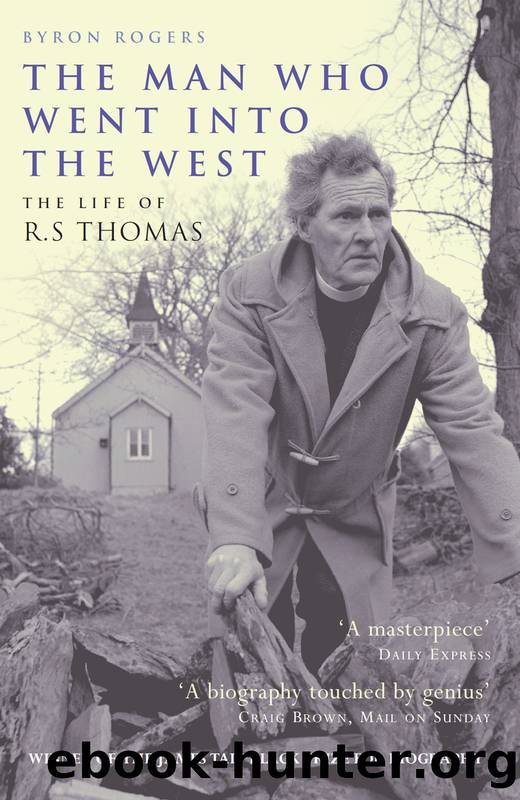
Author:Byron Rogers [Rogers, Byron]
Language: eng
Format: epub
ISBN: 9781845137571
Publisher: Aurum Press
John Jones, that Heimdall of the hills, was also there. âI was very bored. I was eighteen or twenty, and when H.D. had asked permission for him to come, people hadnât said âNoâ, but not many had said âYesâ either. You know how it was then between church and chapel. His Welsh was a bit lumpy, rough you could say. I can see him now. He was just like...an object really. We had a job to understand him, people were not taking a lot in. Vicars are not like chapel ministers, they donât give much of a sermon, they just read it out. Afterwards nobody said anything.â
Thomas would climb the hills most days. âHe must have known every nook and cranny up there,â said Eric Jones Llwyn Copa. It became a talking point among his parishioners. âSometimes my father would see him up there, and heâd look wild,â said Megan Humphreys of Manafon.
His fitness even in old age was remarkable; in his late thirties on the hills it must have been fearsome as he paused up here to see the Wales of his imagination, the mountain Cadair Idris to the north-west, the Berwyns to the north-east, âa prospect to raise the heart and make the blood singâ, wrote the pacing vicar. His responsibilities were far below him, and from 1,000 feet seemed manageable. âTurning to look down into the valley he would see âeverything in perspective ...ââ It is a significant choice of phrase, and what he saw in perspective was âthe people like ants below him, the church a small hut in the fields, and the river like a silver thread flowing down the valleyâ (Neb).
But two things still worried him. The first was that the Wales of his imagination contained that company to which he aspired, the writers in the Welsh language: would they accept him as one of their own?
That he was not sure of this must lie behind the rather mysterious parable in Neb which involves the Welsh-language novelist Islwyn Ffowc Elis, a chapel minister, then living some ten miles from Manafon. âThe rector called by one day to invite him to come for a walk to the moorland around Cwm Nant yr Eira, but Islwyn refused. He was too busy trying to save his own Wales. Were the two Waleses the same?â That is it, there is no more.
Then something happened. In 1951 the War Office decided to extend a British Army camp at Trawsfynydd in North Wales. Now the War Office already owned 10 per cent of the whole surface area of Wales, having requisitioned more land from a country itself one-tenth the size of England and Scotland than from the other two put together. This time some Welsh writers and nationalists decided to block the road in protest. âThe rector started first thing in the morning,â wrote Thomas in Neb, but what actually happened, as described by Islwyn Ffowc Elis in the Welsh-language magazine Taliesin, was a little different.
Whatever Ffowc Elisâs aversion to
Download
This site does not store any files on its server. We only index and link to content provided by other sites. Please contact the content providers to delete copyright contents if any and email us, we'll remove relevant links or contents immediately.
| Ancient, Classical & Medieval | Anthologies |
| British & Irish | Japanese & Haiku |
| Love Poems | Regional & Cultural |
| Themes & Styles | United States |
| Women Authors |
The Universe of Us by Lang Leav(15124)
The Sun and Her Flowers by Rupi Kaur(14566)
Adultolescence by Gabbie Hanna(8962)
Whiskey Words & a Shovel II by r.h. Sin(8050)
Love Her Wild by Atticus(7790)
Smoke & Mirrors by Michael Faudet(6232)
Wiseguy by Nicholas Pileggi(5841)
The Princess Saves Herself in This One by Amanda Lovelace(5003)
Love & Misadventure by Lang Leav(4883)
Memories by Lang Leav(4843)
Milk and Honey by Rupi Kaur(4774)
Bluets by Maggie Nelson(4604)
Too Much and Not the Mood by Durga Chew-Bose(4386)
Pillow Thoughts by Courtney Peppernell(4326)
Good morning to Goodnight by Eleni Kaur(4261)
The Poetry of Pablo Neruda by Pablo Neruda(4167)
Algedonic by r.h. Sin(4089)
HER II by Pierre Alex Jeanty(3639)
Stuff I've Been Feeling Lately by Alicia Cook(3489)
